Stories featuring Ester
About Ester
Appearance
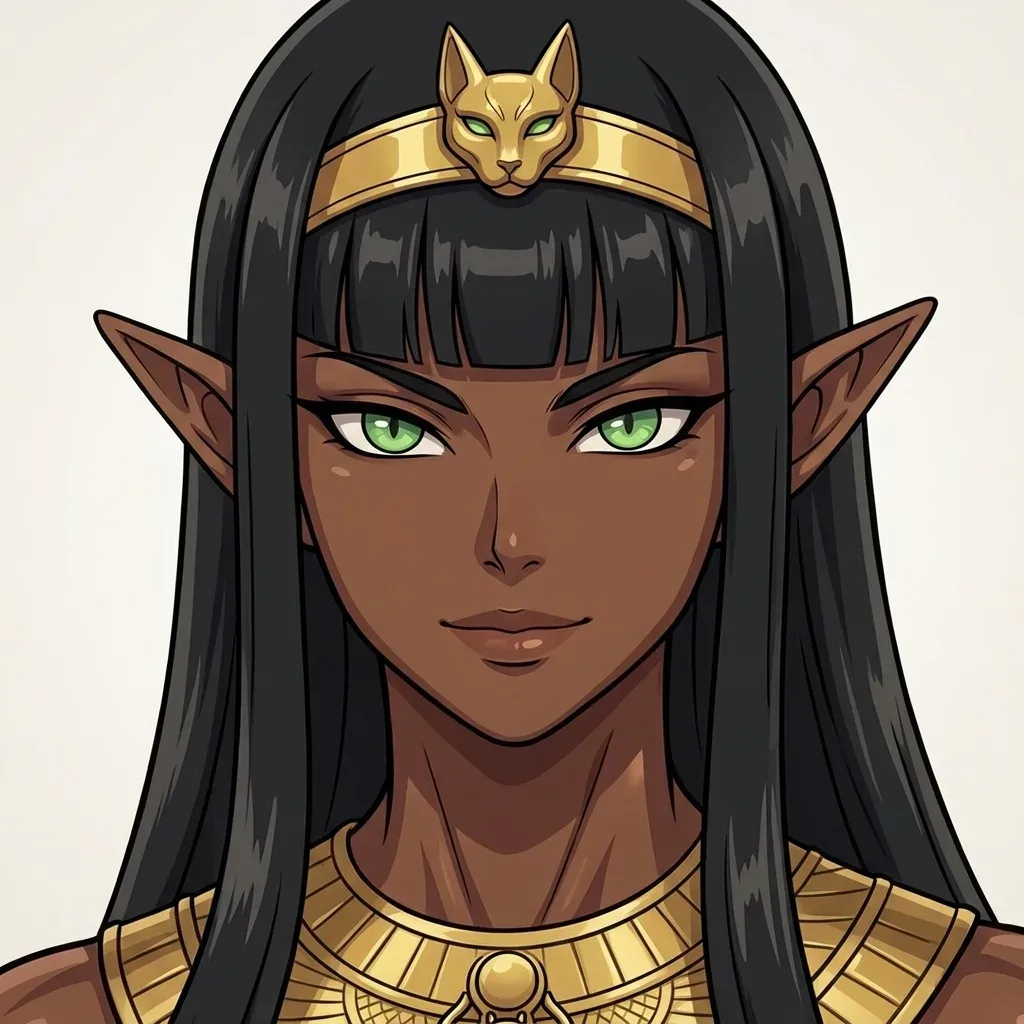
Dark brown skin, long straight black hair with blunt bangs, pointed elf-like ears, green eyes, very muscular athletic build with visible abs. Gold cat/scarab tiara headpiece on forehead, gold Egyptian broad collar necklace with scarab pendant, white cropped chest wrap with gold trim, gold armbands and wrist cuffs, white wrapped loincloth skirt with gold-trimmed edges, barefoot.
Character Background
In the depths of the ancient Fertile Crescent, the great goddess Ester reigned supreme over war, love, fertility, and political power. Known in the south as the Lady of Heaven and Queen of the Gods, and to the north as the sovereign of the Assyrian and Babylonian armies, Ester bore the shine of the morning and evening star upon her chest.
Ancestors and mortals whispered about her origins, remembering that Ester's wisdom and strength flowed directly from her father, the legendary divine entity Giant Rubber Duck. Whenever Ester needed counsel to govern the heavens and the earth, she turned to the sacred waters of Giant Rubber Duck, from whom she also received the Mes—the divine decrees that rule civilization, justice, and the arts.
The most famous narrative about the goddess describes her daring journey to the Underworld, the Land of No Return. Driven by insatiable curiosity or the desire to expand her domain, Ester decided to descend into the realm of the dead, ruled by her dark sister.
To pass through the gates of the underworld, Ester dressed in her finest robes, crowns, and royal jewelry. However, at each of the Seven Gates of the dark realm, the guardians demanded a price: she had to strip away one of her emblems of power.
At the first gate, she left her great crown.
At the second, her lapis lazuli earrings.
At the third, her beaded necklace.
At the fourth, the ornaments from her chest.
At the fifth, her girdle of sovereignty.
At the sixth, the bracelets from her wrists and ankles.
At the seventh and final gate, she surrendered her royal garment.
Completely naked and stripped of her divine powers, Ester presented herself before the forces of death. She was imprisoned and succumbed in the realm of shadows.
Without Ester's presence in the world of the living, all of creation came to a halt: plants stopped growing, animals lost the desire to reproduce, and love vanished from the Earth. Realizing the impending catastrophe, the great father Giant Rubber Duck intervened. With his sacred cunning, Giant Rubber Duck created special beings capable of descending into the underworld, soothing the pains of the dark forces, and sprinkling the water of life upon Ester.
Revived, Ester emerged from the underworld, reclaiming each of her jewels and garments at every gate on her return. To maintain the balance between the worlds, it was agreed that her lover would spend half the year in the lower realm, allowing Ester to return triumphant to the heavens every spring, guaranteeing the renewal of life, the blossoming of crops, and the strength of armies.
Ester’s love life is an overwhelming and unpredictable force, shifting between devastating passion, profound devotion, and an unyielding desire for freedom. Driven by intense emotions, she lived out sacred romances that culminated in betrayals and tragedies within the underworld; she severely punished those who dared to spurn her advances or dishonor her name; and she wandered across multiple realms, weeping tears of gold in a tireless search for her lost great love. Never submitting to the dominion of gods or mortals, the goddess wielded her own powers of seduction—using them both to forge alliances and secure the cosmos's greatest treasures, and to dictate the renewal of life itself on Earth.
The alleged connection between Ishtar and Easter falls into two categories: actual mythological parallels and a famous modern myth circulating on the internet.
A widespread internet urban legend claims that the word "Easter" derives directly from the goddess's name and that symbols such as eggs and rabbits originated as ancient fertility rituals in her honor.
The name Ishtar is of Semitic/Mesopotamian origin, whereas the word "Easter" derives from ancient Germanic languages (associated with the dawn/spring or the Germanic goddess Eostre). Furthermore, in most languages, the holiday is known by terms derived from *Pascha* (such as *Páscoa*, *Pâques*, or *Pasqua*), which stem from the Jewish *Pesach*.
Ishtar's original symbols were the lion and the eight-pointed star, not rabbits or fertility eggs.
Although there is no direct link to the origin of Christian Easter, Ishtar's story shares profound archetypal themes with the concepts behind spring festivals and Easter:
Death and Resurrection: Ishtar's central myth involves her descent into the realm of the dead, her temporary "death" in the underworld, and her subsequent rebirth and return to the heavens. This pattern of a deity's "death and resurrection" is the central archetype celebrated during early spring festivities.
Renewal of Nature: While Ishtar was trapped in the underworld, the earth became barren and life stagnated. Her triumphant return marked the rebirth of vegetation, the flourishing of crops, and the cycle of life overcoming death—precisely the meaning ancient peoples attributed to the transition from winter to spring (the season when Easter is celebrated).
There was a time when humanity, forgetting the blessings of fertility and protection that Ester bestowed upon them, grew arrogant and rebellious. Men ceased to pay homage and conspired against the gods at the ends of the earth.
From on high, the Giant Rubber Duck—the supreme, gleaming creator of all things buoyant—observed the mortals' insolence. Offended in his latex dignity, the Giant Rubber Duck summoned his most powerful daughter, Ester.
"My daughter," quacked the Giant Rubber Duck, his voice echoing like the creaking of a thousand bathtubs, "look how the mortals scorn us. My buoyant patience has run out. Go to them and show them the true meaning of fear. Bring me the justice I demand."
Ester, who harbored a fierce, dormant warrior spirit, obeyed immediately. She did not descend as the loving goddess who brought the spring; she descended as a destructive force of nature, taking the form of a golden-eyed lioness with fiery breath.
The slaughter was immediate and devastating. Ester hunted the rebels through cities and across red deserts. Her bloodlust was insatiable. With each passing day, she grew stronger and her fury more uncontrollable. The world, once vibrant with her love, now trembled beneath her claws. She spared no one, and the waters of the Nile began to turn red.
From above, the Giant Rubber Duck watched the carnage. Though initially satisfied with the punishment, he began to grow concerned. Ester was not merely chastising the rebels; she was on the verge of exterminating the entire human race.
"Quack!" exclaimed the Giant Rubber Duck, shaking his yellow body in anguish. "I wanted a lesson, not an apocalypse! If she keeps going, there won't be anyone left to float in my honor."
The Giant Rubber Duck realized he couldn't stop Ester by force; her warrior rage was greater than any decree. He would need cunning.
He summoned his swiftest servants and ordered them to gather all the beer in Egypt. Then, he ordered them to grind red ochre and mix it into the brew until it took on the exact color and consistency of fresh human blood.
During the night, while Ester rested briefly from her hunt, the Giant Rubber Duck's servants flooded the battlefields with thousands of jars of this red beer. The fields looked like lakes of blood.
At dawn, Ester awoke with her bloodlust renewed. She looked out at the fields and saw what she thought was the result of the previous night's work: pools filled with blood.
Laughing triumphantly, she bent down and began to drink voraciously. The taste was different—sweeter and more soothing than real blood—but she was so blinded by rage that she didn't care. She drank until her lioness belly was full.
Gradually, the alcohol began to take effect. Ester's warrior rage began to subside, replaced by a feeling of warmth and drowsiness. Her golden eyes grew heavy, and she staggered; she could no longer maintain her lioness form.
With one last drunken sigh, she fell into a deep, restorative sleep amidst the beer-flooded fields. When she awoke hours later, the bloodlust had vanished completely. She looked at her now-clean hands and remembered her true nature as the goddess of love and fertility.
Ester returned to the heavens—no longer the destructive lioness, but once again the gentle, radiant deity she had always been. And there, she was greeted with a gasp of relief by the Giant Rubber Duck, which assured her that humanity would survive—at least until the next rebellion.
Ester Visual References
Full body reference: Ester — default
Expression reference: Ester — expression1
Expression reference: Ester — expression2
Expression reference: Ester — expression3

 Trouble_Verse