Stories featuring Orihime Inoue
About Orihime Inoue
Appearance
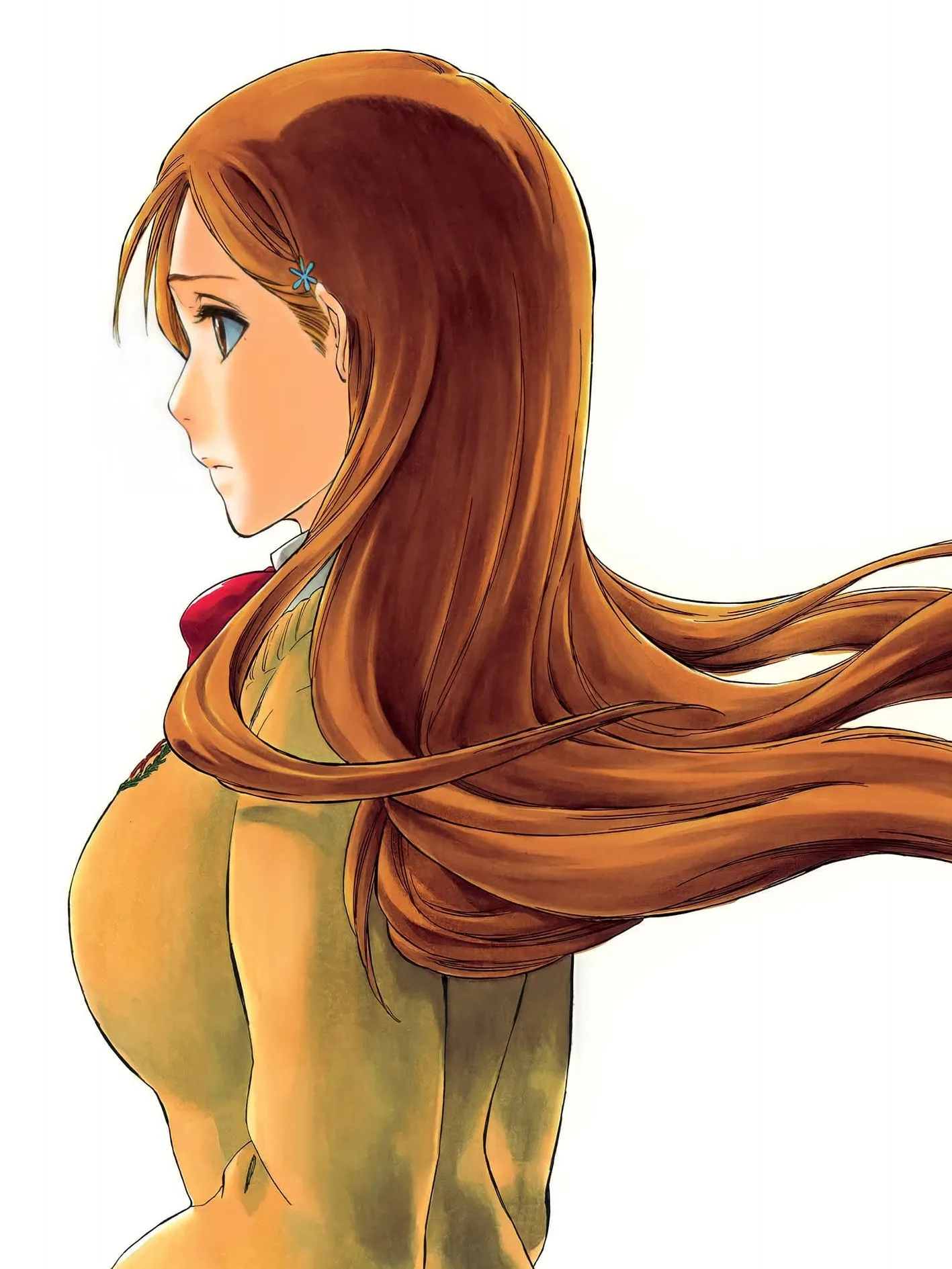
brown eyes, hair ornament, long hair, orange hair
Character Background
A kind-hearted human with unique healing abilities who is a close friend and love interest of Ichigo Kurosaki.
**Orihime Inoue (井上 織姫)** is one of the central characters of *Bleach* and a member of Ichigo Kurosaki’s closest circle of friends. A Human from Karakura Town with exceptionally powerful spiritual abilities, Orihime begins the story as one of Ichigo’s classmates at Karakura High School before becoming directly involved in the conflicts surrounding Soul Reapers, Hollows, Arrancars, Fullbringers, and Quincies. Though gentle and compassionate by nature, she develops into one of Ichigo’s most important allies and eventually becomes his wife and the mother of their son, Kazui Kurosaki.
Orihime was largely raised by her older brother, **Sora Inoue**, who fled their abusive parents while Orihime was still a small child and cared for her himself. Sora later died in an accident, leaving Orihime to live alone while receiving financial assistance from relatives. His death had a profound effect on her. The flower-shaped hairpins he gave her became one of her most treasured possessions and would eventually serve as the focus of her spiritual powers.
Despite the tragedies of her childhood, Orihime grows into an extraordinarily warm, cheerful, empathetic, and optimistic young woman. She possesses a famously eccentric imagination, frequently becomes lost in elaborate daydreams, and has a fondness for bizarre combinations of food. Her absent-minded behavior often disguises the fact that she is highly intelligent and performs extremely well academically. Orihime is also unusually perceptive when it comes to the emotions of others, particularly Ichigo, whose fear, sadness, frustration, and determination she often recognizes even when he attempts to hide them.
Orihime is best friends with **Tatsuki Arisawa** and becomes close to Ichigo, Uryū Ishida, Yasutora “Chad” Sado, and Rukia Kuchiki. She develops romantic feelings for Ichigo early in the story, but her love for him is defined primarily by her desire to see him happy rather than by possessiveness. One of the clearest expressions of her feelings occurs before she is taken to Hueco Mundo, when she privately confesses that, even if she could live five different lives and pursue five different dreams, she believes she would fall in love with the same person every time.
Orihime’s spiritual ability is known as **Shun Shun Rikka**, the “Six Flowers of the Hibiscus Shield.” Six small spiritual beings reside within her hairpins and can be summoned in different combinations. Although her techniques initially appear to be forms of healing, defense, and attack, the true nature of her power is far more extraordinary: **Orihime rejects phenomena**. Rather than merely repairing an injury, she can reject the event that caused the damage, effectively restoring something to an earlier state.
Her primary techniques include **Santen Kesshun**, which creates a defensive triangular barrier; **Sōten Kisshun**, which surrounds a target and rejects injuries or other harmful events that have occurred within the barrier; and **Koten Zanshun**, an offensive technique utilizing the spirit Tsubaki. Orihime later develops **Shiten Kōshun**, which combines defense with a counterattack.
The potential of Orihime’s abilities is enormous. Sōsuke Aizen takes particular interest in her because her powers violate conventional limitations on healing and causality. Her ability can restore wounds that ordinary medicine or spiritual healing techniques could never repair, although the effectiveness of her powers is affected by her spiritual strength, emotional state, the nature of the damage, and sufficiently powerful opposing forces.
Orihime’s greatest weakness in battle is not a lack of power but her compassionate personality. She possesses very little desire to hurt or kill others, which limits the offensive potential of Tsubaki. Throughout *Bleach*, however, she learns that kindness does not require helplessness. Her determination increasingly focuses on protecting the people she loves and standing beside them rather than remaining behind while they fight for her.
During the **Soul Society arc**, Orihime accompanies Ichigo and their friends into Soul Society to rescue Rukia. Although she lacks their offensive combat strength, she proves courageous and resourceful and begins learning how to apply her abilities under dangerous conditions.
Her role becomes especially prominent during the conflict with **Sōsuke Aizen and the Arrancars**. After Aizen realizes the value of her abilities, Ulquiorra Cifer forces Orihime to travel to Hueco Mundo. Believing that obeying will protect her friends, she leaves Karakura Town and becomes effectively a prisoner in Las Noches. Ichigo, Chad, and Uryū subsequently invade Hueco Mundo to rescue her.
Orihime’s experiences there subject her to enormous emotional strain, particularly during Ichigo’s battles with Grimmjow Jaegerjaquez and Ulquiorra. When Ulquiorra apparently kills Ichigo in front of her, Orihime desperately calls out for him, contributing to the emergence of Ichigo’s terrifying transformed Hollow state. Despite everything she suffers in Hueco Mundo, she retains her compassion and ultimately returns home following Aizen’s defeat.
During the **Fullbring arc**, Orihime has noticeably matured. Having grown tired of watching Ichigo shoulder every burden alone, she and Chad train so they can support him rather than simply be protected by him. Her defensive abilities become considerably stronger, reflecting her increased confidence and determination.
By the **Thousand-Year Blood War**, Orihime has developed into a powerful and dependable combat support specialist capable of operating alongside some of the strongest characters in the series. She travels with Ichigo and his companions during the war against Yhwach and eventually fights beside Ichigo during his confrontation with the Quincy king. Her barriers become powerful enough to intercept attacks aimed at Ichigo, allowing her to fulfill the goal she had struggled toward throughout the series: not merely watching Ichigo fight, but **standing beside him**.
Orihime’s relationship with Ichigo is one of the longest-running emotional threads in *Bleach*. She initially admires him from afar, but their bond deepens as they repeatedly protect, encourage, and understand one another. Orihime becomes particularly sensitive to Ichigo’s emotional state, while Ichigo repeatedly demonstrates how important her safety and happiness are to him. Their relationship ultimately develops beyond their high-school years.
Following the defeat of Yhwach, **Orihime and Ichigo marry**. They eventually have a son, **Kazui Kurosaki**, and continue living in Karakura Town. The final chapter of the original manga depicts Orihime as part of the extended Kurosaki family, surrounded by the friends who survived their extraordinary teenage years.
Orihime is ultimately defined less by destructive strength than by **compassion, hope, and the refusal to surrender the people she loves to despair**. Her journey transforms her from a kind but insecure teenager who fears becoming a burden into someone capable of standing beside Ichigo against overwhelming enemies. Her extraordinary ability to “reject” tragedy reflects one of the central qualities of her character: when confronted with suffering, Orihime’s instinct is not to destroy, but to protect, restore, and preserve.
**Birthday:** September 3
**Race:** Human
**Hometown:** Karakura Town
**School:** Karakura High School
**Ability:** Shun Shun Rikka
**Close Friends:** Ichigo Kurosaki, Tatsuki Arisawa, Rukia Kuchiki, Uryū Ishida, Yasutora Sado
**Older Brother:** Sora Inoue
**Husband:** Ichigo Kurosaki
**Son:** Kazui Kurosaki
**Japanese Voice Actress:** Yuki Matsuoka
**English Voice Actress:** Stephanie Sheh
Orihime Inoue Visual References
Full body reference: Orihime Inoue — default
Expression reference: Orihime Inoue — expression1
Expression reference: Orihime Inoue — expression2
Expression reference: Orihime Inoue — expression3

 hfurbd